
RESINPRO 16kg Non-Toxic Clear Epoxy Resin Kit - Water Effect, Glossy
You save £16.24
Description
This 16kg kit of Ultra Clear Multipurpose Epoxy Resin is highly efficient for castings, table making, and DIY projects up to 2 cm thickness. Trust this crystal clear epoxy for all your projects, big or small, whether pouring a large commercial table or creating a handmade gift.
TECHNICAL DATA:
- Mix ratio: 100:60 by weight
- Pot-life (150 gr at 30 C) [0.33 lb at 86 F]: 1h20 ′
- Full catalysis after 24h
- Film catalysis (1.5 mm at 30 C) [0.05” at 86 F]: 6h00 ′
- Maximum pouring level: 2cm*
If you have limited experience, it is strongly suggested to make a small test before working with a large project.
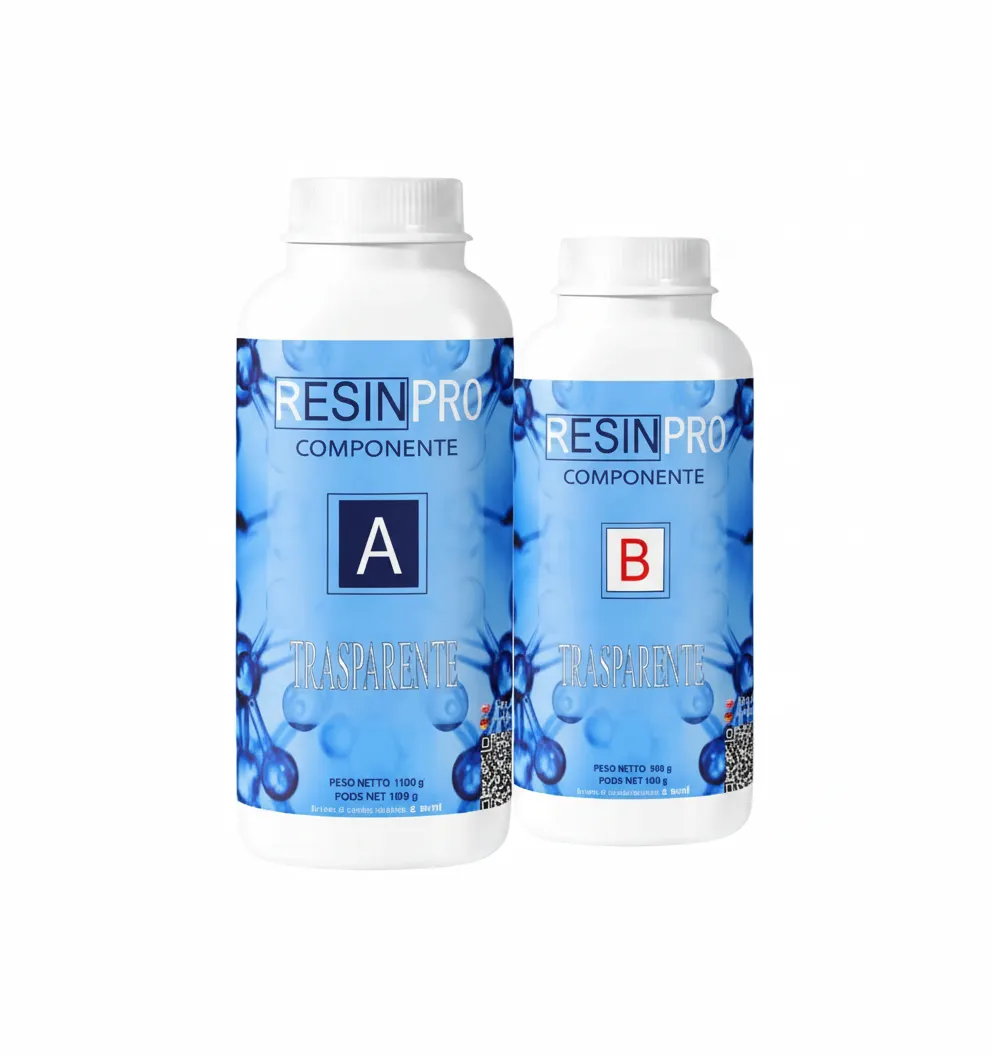
Important: Component B may appear half-filled due to weight proportions. This is not a mistake.
HOW TO USE:
MIX RATIO BASED ON WEIGHT – 100:60
It is not recommended to work with epoxy resin at temperatures below 20 ° C and over 28 ° C, avoiding humid environments (or surfaces) application. If unsure about humidity, allow components to warm up before pouring.
If epoxy resin was stored at temperatures below 20 ° C and became murky, warm the epoxy up before using until full transparency is achieved. More details on defrosting are below.
The proportions are printed on the bottles/tanks. Please check them before using.
As a two-component resin, you will receive two bottles: one containing resin “A” and the other containing hardener “B”. Electronic scales and a mixing container are required to combine the liquids by weight.
How to calculate required hardener:
Using the proportion example of 100:60:
- Take the weight of component A (resin) and multiply by 0.60 for component B (hardener).
- For proportions 100:70, multiply by 0.70.
- For proportions 100:87, multiply by 0.87, etc.
Example: If you have component A (resin) weighing 5kg and the proportions are 100:60, the calculation is 5kg * 0.6 = 3kg of component B (hardener).
Please use electronic scales and weigh in grams for the best results.
After accurate dosage, the resin must be mixed slowly and consistently (always in the same direction) for at least 5-8 minutes. Thorough mixing is crucial; if mixed for only a few seconds, it will not be homogeneous at the molecular level and may remain soft or opaque in parts.
Mix evenly on the edges and bottom of the container. Avoid mixing too quickly or forcefully, as this can cause excessive bubbles. Using a mixer is not recommended, especially at high speeds, as it can lead to microbubbles that are difficult to remove. The more carefully you mix, the fewer bubbles will form.
Remember, the quality of the final casting depends on a good mixing of the two components!
Important: Mix carefully to prevent the formation of small air fractions. While visible bubbles on the surface will often disappear naturally, micro-air fractions are often invisible until curing. During curing and heating, the air within these expands, making bubbles visible in the finished casting. Correct kneading can prevent this.
How to remove bubbles:
While degassing (vacuum) is necessary to eliminate 100% of bubbles, these tricks can help minimize their presence:
- Mix the resin longer but in a more delicate and uniform way.
- Before mixing, heat component A (e.g., in the sun or using a radiator) to make it more liquid, allowing bubbles to rise more easily.
- Allow the mixture to rest for a few minutes to release air bubbles.
- Once poured, use a heat source (thermal pistol or fire, NOT a hairdryer) to burst bubbles on the surface.
COLOURING:
Practically everything, including powder and metallic pigments, can be used as long as they are perfectly dry. When adding pastel or liquid colors, ensure they are compatible with epoxy resins. If not compatible (e.g., enamels, tempera, acrylics), only a few drops should be added, as excessive dosage could compromise the resin's mechanics and brightness (making it soft or sticky). A 'gold rule' is to add no more than 5% of the total mix weight.
Important: Avoid contact of epoxy resin with water! Water ingress can cause the resin to become cloudy or prevent it from solidifying. If the hardener has been stored for a long time with a loosely twisted lid, it can absorb moisture, leading to condensation in the form of microbubbles during the curing process.
AFTER POURING:
After pouring epoxy into your formwork, ensure the room is 'sterile' to prevent dust and dirt from entering the epoxy.
Important: Covering the filling with plywood or dense material is not recommended, as this will disrupt heat dissipation during resin solidification.
Remove micro-bubbles stuck in the surface layer using a hair dryer or a manual gas burner. Avoid overheating the epoxy filling with a burner or hair dryer, as this can cause boiling of the resin.
The full curing time for TRANSPARENT EPOXY resin ranges from 18 to 26 hours (depending on workshop temperature and humidity. Lower temperatures and higher humidity will prolong curing time).
FROZEN EPOXY:
Epoxy can become frozen below 20°C. Do not use frozen epoxy, as this may affect the result.
Even if stored in a warm room, epoxy could have been frozen before. Proper defrosting will restore transparency and liquidity. You will know your epoxy was frozen if component A is murky or solid, like frozen water. This is normal. To defrost, warm component A to 50-70 °C. One method is to place the closed tank in a sink with very hot water for 20-30 minutes. For larger quantities, repeat the procedure if needed, as it may take longer to warm properly. This method has proven effective for defrosting epoxy resin.
After defrosting, cool component A to room temperature before using.
HOW TO AVOID OVERHEATING:
Maximum pouring level: 2cm. This may vary based on the total weight of poured epoxy, project size, and pouring temperature. Not following instructions may cause overheating.
If a larger layer is needed, pour in several steps:
- Wait 8-10 hours after the first pour.
- Wait 10-12 hours after the second pour.
- Wait 12+ hours after the third pour.
When creating a coating with epoxy resin, do not fill the mixture with a thickness of less than 1.5-2 mm; otherwise, after curing, there is a chance of shrinkage with the formation of 'craters' – small depressions on the surface.
If one side of the casting is more than 100cm long, create your project in layers (each layer 1-2cm thinner than recommended) with the time intervals mentioned above.
If you are doing a round casting and the required total weight (A+B) exceeds 3kg, create your project in the same layered way (less thickness per application + longer waiting between layers).
Be especially careful when working with large castings. When mixing a large amount of resin, do not leave the mixture for a long time in one container – pour it immediately into other smaller containers to avoid the 'mass' effect: the resin can heat up quickly and harden instantly with defects, making it impossible to adjust.
If your project includes more than one of the mentioned exceptions, reduce the size of your application further.
ELIMINATING SURFACE OPACITIES OR SMALL WAVES:
These surface opacities result from interaction with environmental humidity, which creates a patina on the cast surface. Initially not obvious, opaque halos and even 'wrinkles' may appear as it begins to solidify.
Strategies to avoid this:
- Work in low humidity (dehumidified) or heated conditions.
- Heat the two components before mixing (e.g., over a radiator).
- Mix the resin with the hardener and apply it only when it starts to heat up (meaning the reaction begins while still in the container). This operation is essential but requires minimal attention. Check every 5-6 minutes; as soon as it reaches 40 ° C (warmer than your hand), it can be applied. Otherwise, it could start solidifying in the container!
- Avoid applying during the night or when it is raining (as humidity increases).
- Do not apply on surfaces that still contain humidity, such as fresh cement or non-dried wood.
If, due to humidity, the resin is not glossy, simply pour a new layer over it (following the instructions above), and it will become perfectly transparent and regular.
Additional Tips:
- Using a mixer (especially at high speeds) is not recommended, as this leads to the formation of microbubbles, which are difficult to remove. Careful mixing minimizes bubbles.
- If embedding something in your project during curing, do not leave it overnight. Curing times vary depending on temperature, mixing time, volume, etc., and can be faster than expected. Pouring in the morning and swirling throughout the day is advised.
WARNINGS:
During processing, use protective masks, gloves, and other protective clothing.
In case of contact with eyes, immediately rinse with cold water for 15 minutes and immediately consult a doctor.
Item Details
- Condition
- New
- Brand
- Resin Pro
- Unit Type
- kg
- Country/Region of Manufacture
- Italy
- Unit Quantity
- 8