Jurassic UK Fossil Ammonite Parkinsonia Raricostata Dorset UK + Display Stand
You save £5.14
Description
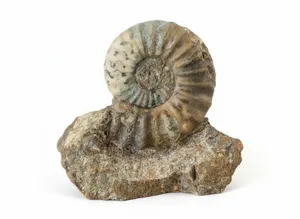
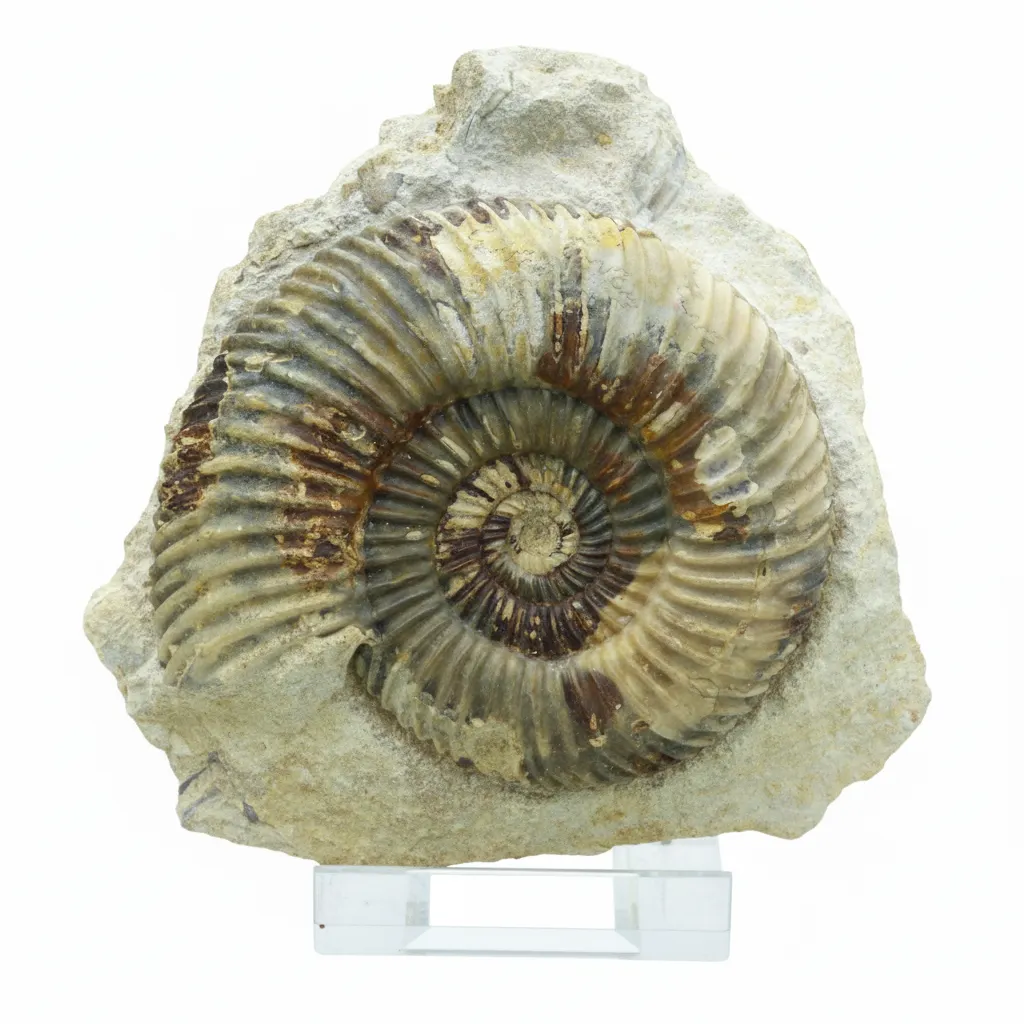
Jurassic Fossil Ammonite Parkinsonia Raricostata with Display Stand
Attractive and nicely preserved ammonite of species Parkinsonia Raricostata from Burton Bradstock in Dorset. These ancient sand coloured ammonites are an extinct genus of cephalopod that lived during the Jurassic period. The beautiful spiral pattern is a reflection of the wonder of nature.
Ammonites, with their spiral patterns, represent the symbol of change and positive motion. In healing circles, it is thought that the spiral pattern filters negative energy through the chambers, yielding and releasing fresh, new energy.
The ammonite gives a glimpse into Jurassic life below the sea, and would make an interesting educational gift, addition to a collection, or something natural and beautiful to display in the home, office or in an educational setting. Supplied with an acrylic display stand.
- Date: Jurassic, Bajocian 170.3 to 168.3 MYO
- Provenance: Burton Bradstock, Dorset, UK
- Size: 10 x 10.5 cm
- Weight: 423 gm
- Condition: There is some good detail. As they are entirely natural, there may be small flaws.
What is a Fossil?
Fossils give fascinating prehistorical evidence of past life on our planet. Usually, fossilization starts once the animal or plant has died. Most animals and plants are eaten or simply recycled back into the earth. The best fossils occur when this process happens rapidly, shortly after death has occurred. Conditions have to be exactly right for a fossil to be produced. Most commonly, this is below water. Decay and deterioration are slowed down because the specimen is covered or entombed in either sediment, muds, sands or volcanic ash or other material, layer upon layer, and over a period that is hard to imagine, usually thousands to millions of years.
Preservation takes place very gradually; as it compacts, it slowly turns to rock. Over time, the plant or animal is replaced by minerals and with chemical changes, leaving an extraordinary replica of the original. In some cases, the pressure and temperature increase, caused by sedimentation, can result in the release of hydrogen and oxygen, leaving a carbon impression of the specimen in sedimentary rock. This process is called carbonization.
Fossils can become preserved in various different ways. For example, wood can become petrified by a process of minerals seeping into the saturated wood, resulting in a gradual process of the wood becoming hard, and resembling stone, often with extraordinary colours. In permineralization or petrification, after the soft structures have decayed, the hard parts, in particular bones, remain. In some cases, other minerals completely replace the original specimen. Generally, most fossils represent the hard parts such as bones, shells, leaves, seeds or woody parts of plants.
Fossils can be internal or external moulds of the original specimen. They can also be some of the original matter, impregnated with chemicals such as silica or calcite.
Fossils can also be indirect, such as in animal footprints or burrows. These are known as trace fossils.
Item Details
- Condition
- New
- Sub-Type
- Ammonites
- Type
- Fossils
- Shape
- Natural
- Country/Region of Manufacture
- United Kingdom
- Finish
- Polished
- Modified Item
- No